
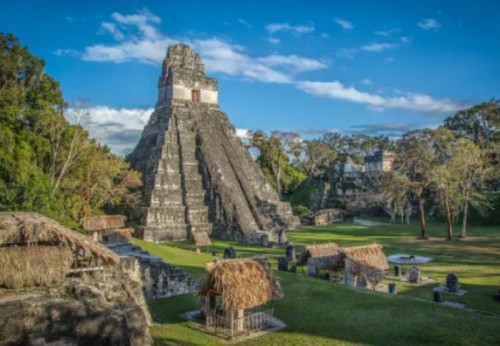
Unveiling the Maya Civilization: Mysteries, Achievements, and Legacy
-
- 0 Share
- 1273 Views
The Maya civilization was one of the most advanced and influential ancient cultures in the Americas. Flourishing for over 2,000 years, the Maya left behind a rich legacy in art, architecture, mathematics, astronomy, and writing. They are known for their impressive cities, grand temples, and intricate understanding of the cosmos.
1. Origins and Development
The Maya civilization began to form around 2000 BCE in what is now southern Mexico, Guatemala, Belize, Honduras, and El Salvador. Their society reached its peak during the Classic Period (250-900 CE), with numerous city-states flourishing across the region.
Pre-Classic Period (2000 BCE - 250 CE): Early Maya societies began to establish agricultural systems and small villages. The first monumental architecture began to appear.
Classic Period (250 CE - 900 CE): This was the height of the Maya civilization, with great cities like Tikal, Palenque, Copán, and Calakmul. The Maya developed advanced systems of writing (hieroglyphs) and mathematics, as well as a sophisticated calendar and astronomical knowledge.
Post-Classic Period (900 CE - 1500 CE): After the fall of many southern cities, the Maya continued to thrive in the northern Yucatán Peninsula, with cities like Chichen Itza and Uxmal.
2. Society and Culture
The Maya society was highly organized, with a strict social hierarchy and complex political systems. Some key aspects include:
- Social Structure: Maya society was structured around a ruling elite, including kings or ajaw, nobles, priests, artisans, and farmers.
- Religion: The Maya practiced polytheism, worshiping numerous gods related to natural elements like the sun, moon, rain, and maize. Human sacrifice was occasionally performed as part of religious ceremonies.
- Writing System: The Maya developed a unique system of hieroglyphs, combining logograms and syllabic symbols. They used this system to document historical events, political affairs, and astronomical data.
- Mathematics and Astronomy: The Maya were ahead of their time in mathematics, creating a place-value system and the concept of zero. Their astronomers could predict eclipses, track planetary movements, and devise complex calendars, including the famous Mayan Long Count Calendar.
3. Major Achievements
- Architecture: The Maya built grand pyramids, palaces, and temples. Notable structures include the Temple of the Inscriptions in Palenque and the El Castillo pyramid in Chichen Itza.
- Art: Maya art is known for its intricate murals, pottery, and stone carvings that often depicted gods, rulers, and mythological scenes.
- Calendar System: The Mayan calendar was a sophisticated tool for tracking time. The Haab’ (solar calendar) and the Tzolk’in (ritual calendar) were used alongside the Long Count Calendar to record dates spanning thousands of years.
4. Decline of the Maya Civilization
The decline of the Maya civilization is still debated by scholars, but several theories have been proposed:
- Environmental Factors: Deforestation and soil erosion caused by agricultural practices may have led to a collapse of the agricultural system, leading to food shortages.
- Climate Change: Prolonged droughts could have contributed to the fall of the southern cities, as water sources became scarce.
- Political Instability: Internal conflicts, warfare, and competition among city-states may have destabilized the civilization.
- European Conquest: The arrival of the Spanish in the 16th century brought diseases, warfare, and the eventual downfall of the Maya in many regions.
5. Legacy of the Maya Civilization
Though the Maya civilization declined in the southern region by the end of the Classic Period, the culture persisted in the northern Yucatán and beyond. Today, the Maya people continue to live in Central America, maintaining many of their traditions, languages, and practices. The Maya left behind an extraordinary legacy in terms of art, science, and culture that continues to captivate historians, archaeologists, and the world at large.
Interesting Facts:
- The Maya were among the first to develop a concept of zero, which greatly influenced mathematical and scientific development.
- The Mayan pyramids often had astronomical significance, with their alignments reflecting the movements of celestial bodies like the sun and moon.
- The Maya ballgame, played with a rubber ball, was a cultural and religious event, with ritual sacrifices sometimes tied to its outcome.
Please