
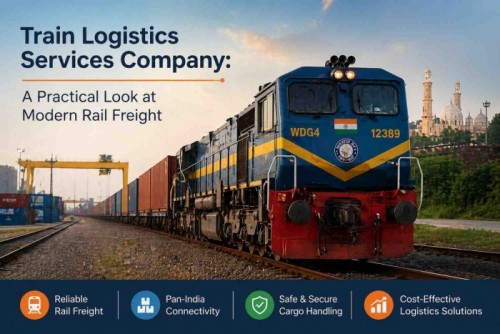
Choosing the Right Train Logistics Services Company in India
-
- 0 Share
- 235 Views
Road transport works well until rising fuel costs, inconsistent transit schedules, and long-distance freight begin affecting profitability. Many businesses shift to rail expecting immediate savings, only to discover that moving cargo by train requires a different level of planning. Route availability, terminal coordination, loading schedules, and first-mile and last-mile connectivity all become part of daily operations. That is why selecting a dependable train logistics services company is not simply about booking rail transport. It is about building a freight strategy that remains reliable under operational pressure. Businesses that understand this early usually avoid costly disruptions and develop a supply chain that scales more predictably over time.
Key Takeaways
- Rail freight succeeds through disciplined planning rather than faster execution.
- Small scheduling mistakes often create delays across the entire supply chain.
- Cost savings disappear when first-mile and last-mile coordination is ignored.
- Long-distance freight requires continuous operational monitoring, not one-time planning.
- The right logistics partner focuses on consistency as much as transportation costs.
Rail Freight Is More Than Moving Cargo Between Cities
Many businesses compare rail transport with trucking only from a cost perspective. On paper, rail usually appears more economical for high-volume shipments travelling long distances. The operational reality is more complicated.
A train logistics services company does far more than reserve wagon space. It coordinates loading windows, manages documentation, plans cargo movement between warehouses and rail terminals, monitors transit progress, and ensures deliveries remain aligned with production schedules. When even one stage falls behind, the impact spreads across the entire distribution network.
I have seen companies move to rail because transportation costs looked attractive during planning. The first few shipments performed well, but operational problems appeared once dispatch volumes increased. Warehouse teams loaded cargo according to production schedules instead of train departure schedules. Finished goods reached terminals late, wagons missed planned departures, and inventory remained idle until the next available service. The expected savings gradually disappeared through storage costs and delivery delays rather than transportation charges.
This is usually where projects become messy. The railway itself is rarely the problem. Poor coordination between internal teams, transport contractors, and warehouse operations creates delays that no tracking system can solve later.
Experienced businesses treat rail freight as a coordinated operational workflow instead of a standalone transport activity. That mindset produces far more predictable results than focusing only on freight rates. Businesses looking for planned shipment logistics solutions often discover that operational discipline has a bigger impact on performance than the transport mode itself.
The Biggest Operational Challenges Begin After Implementation
Most planning timelines look reasonable until real execution begins. Initial shipments receive close attention, communication remains frequent, and exceptions are resolved manually. Once shipments become routine, operational discipline often starts slipping.
One thing many teams underestimate is how dependent rail freight is on accurate scheduling. Missing a loading window is not always equivalent to delaying a truck by a few hours. It can postpone cargo movement significantly, affecting warehouse capacity, production planning, customer commitments, and downstream transportation.
This is why experienced organizations evaluate a rail logistics company in India based on operational maturity rather than infrastructure alone. The technical setup is rarely the hardest part. Managing long-term operational consistency usually is.
Businesses searching for affordable train shipment services sometimes discover that lower pricing comes with reduced operational support. Communication becomes slower during disruptions, shipment visibility decreases, and resolving exceptions takes longer than expected. None of these issues appear during the quotation stage, yet they become critical once freight volumes increase.
Another common challenge involves the connection between rail terminals and customer locations. Rail efficiently handles long-distance movement, but cargo still depends on road transportation before loading and after unloading. If those handovers are poorly coordinated, even the most efficient rail journey cannot prevent delivery delays.
Companies investing in long-distance rail logistics solutions should therefore examine the complete operating model rather than focusing exclusively on railway capacity. Consistent coordination between warehouses, transport partners, rail terminals, and customer delivery schedules usually determines whether rail logistics delivers measurable business value or becomes another operational bottleneck.
Why Experienced Businesses Prioritize Reliability Over Freight Rates
Freight pricing often dominates vendor discussions, but it rarely determines long-term logistics performance. Businesses usually remember delayed production, missed customer commitments, or excess inventory long after they forget a slightly lower freight quote.
A capable train logistics services company understands this reality. Its role is not limited to moving cargo by rail. It should anticipate disruptions, provide realistic transit planning, coordinate with warehouse teams, and keep stakeholders informed when schedules change. That level of operational discipline is difficult to measure during procurement but becomes obvious after several months of execution.
I've seen procurement teams award contracts purely on transportation cost. Six months later, operations teams were spending more time resolving shipment issues than managing production. Deliveries became unpredictable, customer service teams handled repeated follow-ups, and warehouse managers adjusted dispatch plans almost daily. The original savings disappeared because operational inefficiency created hidden costs that no rate sheet had captured.
Reliable Train Cargo Services depend on consistent execution rather than isolated successful shipments. Experienced logistics partners build contingency plans, maintain communication across every stage, and monitor shipment progress before delays become customer issues.
Another factor that deserves attention is scalability. A logistics setup that works for ten shipments a month may struggle when volumes double. Capacity planning, terminal handling, and scheduling all become more demanding. This is where businesses benefit from working with a rail logistics company in India that has experience handling seasonal demand, expanding distribution networks, and fluctuating freight volumes.
Building an Efficient Rail Freight Operation
The companies that gain the most from rail logistics usually follow a few practical principles rather than relying on transportation alone.
Align production schedules with train departure schedules instead of warehouse convenience.
Plan first-mile and last-mile transportation before confirming rail bookings.
Maintain regular communication between warehouse, dispatch, logistics, and customer service teams.
Track shipment milestones continuously rather than waiting for delivery exceptions.
Review operational performance regularly to identify recurring delays before they affect customers.
These practices may appear simple, but they prevent many of the operational issues that increase logistics costs over time. Rail freight performs best when every stage supports the next rather than operating independently. Businesses using shipment scheduling services in India often achieve better consistency because dispatch planning becomes more structured and less reactive.
Long-Term Success Depends on Operational Discipline
Many businesses initially view rail logistics as a cost-saving initiative. Over time, they realise it is actually an operational management exercise. Transportation is only one part of the process. Inventory planning, warehouse readiness, dispatch coordination, customer communication, and contingency planning all influence the final outcome.
Choosing a train logistics services company should therefore involve more than comparing pricing or network coverage. Evaluate how the provider manages disruptions, communicates with stakeholders, handles schedule changes, and supports business growth.
The most successful logistics operations rarely eliminate problems completely. Instead, they build systems that identify issues early and resolve them before they affect customers. Businesses that integrate cost-effective train shipment delivery into a broader logistics strategy generally achieve better long-term performance than those focusing only on transportation costs.
Conclusion
Rail freight continues to become a more practical option for businesses moving large volumes across long distances, but success depends far more on execution than intention. One mistake organizations continue to make is assuming lower freight costs automatically translate into lower logistics costs. In reality, poor coordination creates expenses that are far harder to control than transportation rates. Businesses that treat rail logistics as an integrated operational process, rather than simply another shipping method, will be better positioned as supply chains become more data-driven and time-sensitive in the years ahead.
FAQs
1. When should a business choose a train logistics services company?
Ans. Rail logistics is generally suitable for businesses moving high-volume freight over long distances where predictable schedules and lower transportation costs outweigh the need for rapid transit.
2. Are Train Cargo Services cheaper than road transportation?
Ans. For many long-distance, bulk shipments they can be. However, total logistics costs also depend on warehousing, first-mile and last-mile transportation, handling, and operational coordination.
3. What causes delays in rail freight operations?
Ans. Delays often result from missed loading windows, poor coordination between warehouses and transport providers, documentation issues, or inadequate planning around terminal operations rather than the railway network itself.
4. How can businesses improve rail logistics performance?
Ans. Better planning between production, warehousing, transportation, and customer delivery schedules usually has a greater impact than changing logistics providers frequently.
5. What should companies evaluate before selecting a rail logistics company in India?
Ans. Look beyond freight rates. Assess network coverage, operational support, communication processes, shipment visibility, contingency planning, and the provider's ability to scale with business growth.
Please